Misandry: The Invisible Hatred of Men
Men face many microaggressions that we rarely think about
Microaggressions are those subtle (and sometimes not so subtle) things we do to distance ourselves from minorities, be they someone from another race, or culture, LGBT people, etc. The term “microaggression” was coined by psychiatrist and Harvard University professor Chester M. Pierce in 1970 to describe insults and dismissals he regularly witnessed non-black Americans inflict on African Americans[1]. Most people are well-intended and do not mean to be offensive at all—but they are. Some of these include:
- “What are you?” (to a biracial person)
- “You don’t act like a black person.”
- “I am colorblind.”
- “Why do you sound white?”
- “Is that really your hair?”
- “Are you the first in your family to go to college?”
Today the term "microaggression" is also being used to describe insults and dismissals of women and LGBT people. Kevin Nadal does a great job describing microaggressions against LGBT individuals in his book, That’s So Gay: Microaggressions and the Lesbian, Gay, Bisexual and TransgenderCommunity[2]. Some microaggressions against LGBT people include:
- “I’m not being homophobic; you're being too sensitive.”
- “Have you ever had real sex?”
- “So, who's the man in the relationship?”
- “That's totally cool with me as long as I can watch.”
- “You are so Jack on ‘Will and Grace’ or Cam on ‘Modern Family.’”
- “I would never date a bisexual man he can’t commit or make up his mind”
- “What’s going on down there” (To a transgender person)
Some verbal microaggressions I’ve heard against women are:
- “I wouldn’t work for a woman.”
- “If you dress like a slut, you’re asking for it.”
- “She thinks like a man.” (Intended complement)
- “You’re being too emotional. You need to look at this logically.”
- “I’m impressed that a woman could do that.”
- “Why don’t you just get back in the kitchen.” (Supposed joke)
Misandry
I have been noticing more and more microaggressions toward men, but I’ve found surprisingly little discussion of this trend. There is a word most people have never heard of: Misandry, meaning hatred of men. It corresponds to misogyny, hatred of women. By noticing microaggressions directed against men, we can uncover a lot of hidden misandry. Here are some examples I've come across:
- “Men only think with their dicks.”
- “A man wouldn’t understand.”
- “Men just want a hole to put it in.”
- “Men can’t hear the word no.” (When rejected sexually)
- “Men are obsessed with lesbian porn.”
- “Really? You don’t like sports?”
- “He’s, you know, ‘artistic.’”
- “Be a man.”
- Men are womanizers, man-whores, man-sluts.”
I’ve even heard women say things like, “Balls are gross. I hate them.” If a woman overheard men talking about vaginas being dirty and disgusting, she’d surely think this was misogyny and microaggression, but why not the other way around? Many otherwise enlightened people seem to think that putting a man down by shaming him for the transgressions of a few criminalmen or for his inadequate physicality is a sort of privilege or entitlement. They are not even aware of their misandry.
Patriarchy
Mostly we know that men, especially heterosexual white men, have a privileged status in our society, that they are mostly blind to their privilege, and that we live in a patriarchal world. But let’s look at our assumptions for a moment. What does it mean, for instance, when we tell someone to “man up” or “toughen up?”
We often think of patriarchy as hurting women, but we don’t talk about how it also hurts men. Patriarchy includes a rigid standard of looks and behavior, and men who fail to follow the standard are tormented ruthlessly. Conforming men may be "blind to their privilege," but nerds and sissies are fair targets for contempt. A man who dares not be "manly" is scorned by women as well as men. Those “crybabies” deserve what they get.
In his book, I Don’t Want to Talk About It: Overcoming the Secret Legacy of Male Depression [3] author and psychotherapist Terrence Real says, “Boys and men are granted privilege and special status, but only on the condition that they turn their backs on vulnerability and connection to join in the fray. Those who resist, like unconventional men or gay or bisexual men, are punished for it.” I completely agree with him.
The language of hate and love
The old adage, “Sticks and stones may hurt my bones, but words can never hurt me,” is wrong. Words can and do wound. They perpetuate norms that give rise to bigotry, misogyny, misandry, racism, homophobia, and more. Given how “manliness” is enforced by both men and women, is it any wonder that men have become fair targets for a running commentary of contempt?
Even the absence of online discussions of microaggressions against men is itself a microaggression because the absence renders the problem invisible. Some discussions of microaggressions toward women and minorities even say that because men are privileged they can't experience microaggressions. But many men are not privileged. These men have been rendered invisible and at the same time marked as fair game.
It pathologizes men when we assume something is wrong with a guy who doesn’t like sports, isn’t tall, dark, and handsome, or otherwise doesn’t fit a manly stereotype. It also pathologizes men when we assume the worst transgressions of a few are characteristics of all. It doesn’t help women (or blacks or LGBT individuals) to engage in the sport of putting down men. We might begin by extending to men our sensitivity about the harm done by microaggressions. It could open the door to compassion and help us build a more humane world.
References
[1] https://en.wikipedia.org/wiki/Microaggression_theory
[2] Nadal, Kevin. 2013. That’s So Gay: Microaggressions and the Lesbian, Gay, Bisexual, and Transgender Community.
[3] Real, Terrence, 1998. I Don’t Want to Talk About It: Overcoming the Secret Legacy of Male Depression.
Homophobia Is a Real Fear … but of What, Exactly?
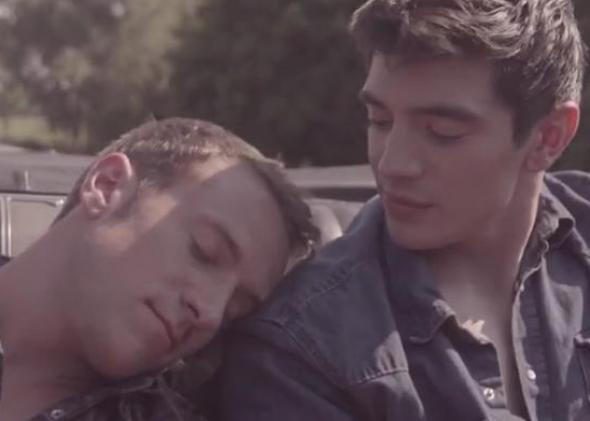
There’s no turning back … and that’s a problem.
Still from Steve Grand’s “All-American Boy.”
To be a homophobe in 2014 is, increasingly, to find oneself on the fast track to social scorn. In an environment of growing acceptance, we condemn homophobic feelings, particularly in men, because we think they come from inside the individual and are thus his full responsibility. A man who says hateful things about gays is “backward.” He’s protecting his social status, or maybe he’s secretly gay himself. He needs to grow up or come out already.
However, the continued existence of homophobia—despite the obvious downsides—raises questions about its basic nature: Do psychological theories like those above really explain why gayness, specifically, evokes such fear, the kind that can sometimes even lead to violent speech and action? Do they account for why homophobia is such an easy bulwark against masculine insecurity? Why does coming out seem so impossible to some men? The only way to answer these questions is to stop thinking of homophobia as a personal choice and understand it as the inevitable and deliberate result of the culture in which American men are raised.
Clearly, men in America have grown up learning to be scared of gayness. But not only for the reasons we typically think—not only, in the end, because of religion, insecurity about their own sexuality, or a visceral aversion to other men’s penises. The truth is, they’re afraid because heterosexuality is so fragile.
Heterosexuality’s power lies in perception, not physical truth—as long as people think you’re exclusively attracted to the right gender, you’re golden. But perception is a precarious thing; a “zero-tolerance” policy has taught men that the way people think of them can change permanently with one slip, one little kiss or too-intimate friendship. And once lost, it can be nearly impossible to reclaim.
Put another way, the zero-tolerance rule means that if a man makes one “wrong” move—kisses another man in a moment of drunken fun, say—he is immediately assumed to be gay. Women have a certain amount of freedom to play with their sexuality (mostly because society has a hard time believing in lesbian sex at all). Male sexuality, on the other hand, is understood as unidirectional. Once young men realize they are gay, they become A Gay Person. We don’t hear about gay men discovering an interest in women later in life, and we rarely believe men when they say they are bisexual—the common, if erroneous, wisdom is that any man who says he is bi is really just gay and hasn’t admitted it yet.
The result of all this is that men are not allowed “complex” sexualities; once the presumption of straightness has been shattered, a dude is automatically gay. That narrative does not allow much freedom to explore even fleeting same-sex attractions without a permanent commitment. I knew a guy who, straight in high school, hooked up with dudes for the first semester of college. He was then in a monogamous relationship with a woman for the rest of college; in the weeks before graduation, I would still hear people express confusion about the existence of their relationship.
The zero-tolerance policy is legitimately scary, then, not just because it sticks you with a label, but also because it erases a lifetime of straightness. One semester of experimentation was worth more than every other hook-up and romance of this guy’s life—both before and afterward.
Indeed, such erasure is scary even if homosexuality itself isn’t a bad thing. Even if religion and Esquire didn’t teach men to be scared of each other’s bodies, they would still be afraid of the way a brush with gayness can so suddenly erase the rest of their sexuality. With so much on the line, it’s no surprise that men take up the job of policing this boundary themselves, lest it be policed by someone else, to their detriment.
It’s worth noting that men confront their fear with brilliant creativity. High-schoolers accuse each other, their activities, and even objects of being gay with precisely the zero-tolerance attitude that they themselves are navigating. A popular game in high school was “fag tag,” where boys slap each other’s packages with the back of their hands. In college they played chicken, where two guys each slide their hand up the other one’s inner thigh. Whoever gets freaked out first loses—or wins, really. These games aren’t just grounded in disgust with homosex; they are playing out exactly what society has taught men about heterosexuality: One wrong move, and you’ll be permanently marked.
Homophobia, then, is precisely a fear, and one that these men are not at all foolish for entertaining. The behavior it engenders is a perceptive response to a sick system, rather than a sickness itself. That’s why I don’t hold a grudge against the kids in high school who said “fag,” or the occasional bartender who makes a weird comment about my date—they’re understandably more scared of me than I am of them.
Why Some Gay Men Hate Pride Parades — And Ourselves
Internalized homophobia can take a lifetime to unlearn.


“Somebody ought to kill those faggots,” the guy sitting next to me muttered. I’ll call him Jake. Our bus rolled past the National Mall in Washington, D.C., where rainbow flags swayed lazily in the breeze in preparation for, as our guide reminded us, a Pride parade later that day. I could see Jake hold himself back, clutching the seat in front of him and lifting his haunches slightly, like a dog prepared to strike. But his hostile body language was speaking to no one in particular. It was morning, and it would be hours before queer people would actually filter out onto the lawn. It was the mere idea of the parade Jake hated.
Jake and I were both from Oklahoma, on a student trip to the capital in 2008. I was there because of an essay contest I had won; he’d been sent as part of his school’s agricultural program. I had to share a bed with him in the hotel. On the first night, he winked at me, bit his finger in mock seduction and said, “You like to snuggle?” I quickly realized that he was one of the worst people I’d ever met.
As for Jake wishing death on the absentee Pride participants, I just rolled my eyes. His language was extreme, but the sentiment wasn’t unique. I was in high school and hadn’t yet come out of the closet, or even acknowledged my sexuality to myself. The gulf between the person I was and a person who might attend a Pride parade — someone who had not only come to terms with being gay, but also had the audacity to announce it — was vast. It was so vast that I hardly felt a thing when the violence of Jake’s words landed on my ears. He wasn’t talking about me, at least then.
Growing up in a straight world means straight people teach us how to think and talk about gay people, even if we’re gay ourselves. “I can’t stand Pride parades,” I told my crew one night, tipsy at a bar in college. I had recently come out, and almost all my friends were straight. My gayness was something new to play with, as novel for me as it was for them. They quizzed me on things as if I were a brand new person, asking what kind of guys I was into, how long I had known. They asked me about Pride parades.
I’m not sure what I hoped to achieve with my answer. I’d never attended a Pride event before, nor did I know what one looked like. I only had a vague image conjured from stereotypes — men dancing around in their underwear, throwing glitter everywhere. Maybe I said I couldn’t stand them to establish distance between myself and these unrepentant gay people I had made up, people I had been conditioned to reject because I felt rejecting them was what I was supposed to do. Maybe it was an impulse of American individualism, the smug Pride in breaking a mold. As a gay man, society expected me to be flamboyant, or so I imagined, and I, being special and different, would not conform.
Or maybe it was fear, uncomplicated and crude, because I had privately retained every threat and insult and disparaging remark I’d ever heard about gay people, even though I’d pretended they didn’t apply to me and I wasn’t bothered, terrible things like what Jake had said, violent things. I had retained them anyway, and maybe I thought I could exempt myself from the collective force of their verdict through compromise. Sure, I’m gay. But I’m not like the gay people you hate, those who bring it on themselves by being so flamboyant.
ADVERTISEMENT
Condemning the Pride parade that night was a convenient way for me to cram everything straight people didn’t like about gay people into one symbolic event and then throw it away. It’s the same line of thinking that social conservatives take, wherein the parade is a sort of bogeyman. To hate Pride is to hate the moral chaos queerness promises upon hegemony, and to condemn it is to protect the status quo it seeks to upend.
It’s more common for homophobes to say they hate the Pride parade than it is for them to say they hate Pride itself. Parades are garish, extravagant things, after all. A parade is not a contained celebration. It exists in the public eye. It asks to be celebrated, challenges its surroundings with its naked desire to be seen; it seeks to make its bystanders collaborators. “But do you really need a parade?” a common retort goes. It rests on the unspoken argument that, by merely existing, the parade has asked the critic to participate. “Do you need to shove it down our throats?”
“Shoving it down our throats” is another common complaint, because at the core of many straight men’s homophobia lies a phantom violation: imaginary gay men who want to touch them without permission, to objectify them, to threaten their masculinity. There was no one on the Capitol Mall that morning in D.C. But Jake rose to defend himself. Over the years, I’ve tinkered with his reaction, tried to solve the puzzle of his animus, because I thought doing so might explain everything.
What I’ve found is that this instinct against Pride parades and gayness in general isn’t confined to straight men. Gay men are also conditioned to see gayness as an intrusion, a disruption. We see gayness punished with violence, and we replicate that violence so as to avoid it. We punish ourselves if we have to, if it keeps others from getting to us first. For gay men who are white and/or cisgender, gay men who are adjacent to the access straight white men enjoy in society, distancing ourselves from anything that marginalizes us can be a way to cling to privilege. It’s not liberation. It’s a facsimile of it. But its rewards are enough for some.
Deeply rooted misogyny and a performed disdain for all things feminine is a hallmark of masculinity, and a necessary action to procure its benefits — like not being harassed or assaulted on the street, a benefit that isn’t on the table for other queer people. The fear is vulnerability, and the Pride parade makes it impossible to hide, to be a chameleon. It exposes. It’s “out.” By participating in that violent tradition of masculinity, we can spare ourselves, even if it comes at the expense of all those in our community for whom it is not an option.
I attended my first Pride parade in Oklahoma City right after I graduated college with someone I’ll call Matthew, one of my first gay friends. I put on a sleeveless shirt and jorts, which I thought was the unspoken uniform, unsure what to expect. Some drag queens standing on truck beds rolled by, throwing beads. There was a lot of rainbow. It did not have the transformative effect I thought it would — I thought once I attended, something final and intense would happen. I would finally be a “real” gay person. But it wasn’t remarkable in that way. I enjoyed myself.
Today I understand that every Pride event is different, and what it means varies widely depending on location and from individual to individual. Some Prides are protests. Some are parties. Some fit the bill of the hedonistic conservative nightmare of promiscuity and alcohol. I’ve been to some of those. They’re fun. Others are family friendly events. As my politics have changed, my critiques of Pride have wrapped around to the other side. I wonder if it is radical enough, if it’s too white, if it’s dominated by cisgender gay men. I wonder if there are too many banks with floats.
ADVERTISEMENT
I’ve also encountered many gay men who parrot the language I used to use for Pride parades. I don’t think anyone has to enjoy Pride, but there’s a certain strand of hating it that sets off alarms for me. It’s the same language many gay men use for feminine gay men, for “the scene.” It’s the language of distance, of condemnation. It’s a vocabulary most of us were taught at an early age; sometimes by parents, sometimes by peers. There are gay men who think if they use it loudly, they can sever the cumbersome bond of community, and the restrictions and marginalization that comes with it.
I wonder if the people who do this had a moment like I had with Jake, a moment where they realized people would not only hate them for existing, but actively seek to punish them for it. I wonder if they even know, as I didn’t know when I first came out and rejected my community at a bar in college, that they’re afraid.

Get the best of what's queer. Sign up for our weekly newsletter here.

No comments:
Post a Comment